Tedi -- Going Downtown ... The move to Atlanta was one which had been in the works for quite a while. Once Tedi got involved in taking art classes at the High Museum School of Art (also confusingly called the Atlanta School of Art at the High Museum!) at Peachtree and 15th Street in Atlanta, she moved into a world of art harking back to her time with Stanton MacDonald Wright in the early 1930s -- the newly-discovered world of "fine art" as opposed to the world of "commercial art" in which she had thrived up to that time! She was greatly influenced by teachers like Ben Shute and Joel Reeves, of whom Ben Shute was a particular influence in her watercolor paintings and Joel Reeves in her general approach as to what art is and/or can be.
For a year or so (1952-1954) Tedi had been taking the Greyhound bus from Marietta to Atlanta almost five days a week to take classes at the High Museum, and at some point began herself to teach locally out of our house at 405 Lawrence Street in Marietta. She was eventually able to arrange to share a studio space in Hazel Butler Roy's "Castle" at the corner of 15th and Peachtree with two other older women students she had became acquainted with in her classes -- Joel Dinkler (wife of Carling Dinkler, heir to the Dinkler Hotels, who unfortunately ended his life very messily by flinging himself out of one of the plate-glass windows of his downtown hotel) and another well-to-do lady named Alma Hartmann (they both drove big 'ole Cadillac cars!) -- both of whom basically (and fortuitously!) paid the rent on the studio. Tedi's paintings of that period reflected the tastes of her (then) teachers and covered a wide genre of styles (something she herself termed 'trying different things'!). She had a natural eye, however, and was good at picking up different styles and producing quite credible works -- many of which she sold very quickly at local art shows and small galleries (with Jimmy helping out by cutting mats and making frames, and at one busy point she even recruited me to cut mats under Jimmy's guidance -- talk about desperation!). In this way she soon developed a modest, but growing, following among local collectors principally looking for works to decorate their homes. She soon progressed from open-air shows to small galleries, even herself helping to open one or two galleries in conjunction with other artists she had come to know (such as the Browse, Borrow or Buy (BBB) gallery on Peachtree). She was fanatical about separating her "fine-art" career from what she considered her "commercial" career -- only peripherally mentioning her earlier "Hollywood" career in occasional interviews, while keeping the details of her Hollywood background pretty much in the dark, and rarely showing her collection of costume designs to anyone in Georgia, even those inside the family (we knew she had kept a considerable amount of her output from her Edith Head days at Paramount, but it was kept carefully tucked away and we were free to browse through all of it only after she was gone -- see Tedi ). She was dismissive of anything she considered to be 'commercial art' and shunned anything she thought might suggest she was turning out artwork purely to sell!
The Rest of Us! ... As for the rest of us, we plodded onwards, with Jimmy commuting up the "four-lane" to Lockheed and back every workday, and Kim and I starting out at our final public school -- Northside High School in Atlanta (sadly no longer in existence as a high school, although the buildings still remain. Go, Tigers!). During our first days and weeks at Northside we were pretty much out of it socially, knowing hardly anyone at the school, so we got involved with a youth group at the local CS church, an entity with the unwieldy name of "Christian Science Monitor Youth Forum." That turned out to be a propitious move, as Northside High was a very well-to-do school with little room for new arrivals such as ourselves to penetrate its hallowed social ranks (particularly starting out from scratch in one's Junior year!). We did make a few friends and enjoyed our time there, but in some ways we were simply in a holding pattern, waiting to move on to a milieu where one's friends of a decade or so were not that important! In 1956 the two of us finally graduated from 12 years and some 15 or so schools worth of primary and secondary education -- Hallelujah! It was probably very gratifying for Jimmy and Tedi to see both of us off to college -- in particular Kim, who penetrated the hallowed halls of Georgia Tech as one of only half a dozen women students in her matriculating class!!
CSMYF ... As mentioned earlier, our contacts with kids of our own age in Atlanta were severely constrained by the fact that we were about to start our junior year of high school in a very "up-market" Atlanta high school district, while knowing hardly anyone at all. We had been through all of this before in three schools in Santa Fe, two in Lubbock, and three in Marietta (only two for Kim!) and things were looking very "deja vu" (all over again, as Yogi Berra so profoundly expressed it!). Just as we were about to write our social life off for the next two years, we became acquainted with the CSMYF (Christian Science Monitor Youth Forum), a social group connected with the Atlanta-area Christian Science churches. Although all the participants in the group were associated with the Christian Science church, they were a surprisingly mixed group, both in age and with respect to the degree in which they bought into the "CS" ethic. It was basically a very clean-cut youth group setting, in which the boy-girl thing very much played a role, but not to the point of excluding those whose social adeptness (or lack thereof!) might have handicapped them in a more "competitive" setting. All were welcome and accepted in a most generous and free-spirited manner, a setting that was often lacking in the typical 1950s teen-age setting, particularly when it came to outsiders (yeah, such as us!) ... For a variety of pictures from many years time, see (CSMYF ) (Mike Jones CSMYF ) (Marilyn Riley CSMYF )
Northside High Bits and Pieces ... School Bus --We lived about a mile's walk away from the high school, which involved trudging along Northside Drive -- a somewhat hairy dance with traffic, but one which I did almost every day coming home from school in the afternoon. There was a school bus which we could take about a block from the house on Howell Mill Road, but it was looked on as very declassé. Nevertheless, having no other transportation and not being very cool anyway, we took it every morning. ROTC -- One of the novel aspects of Northside High was the fact that it required that all boys take two years of ROTC! I had never seen this before or since in any other high school setting (and we went to lots of schools, including Marietta High, just up the road!). It was a real pain, as it involved wearing a full military uniform to school on drill days, which were, as I recall, two days a week. The class was just one hour a day, but it seemed like a total waste of time. The credit did not carry over to college, and the whole thing was something dreamed up by some military-heavy Atlanta school board. The class was required for two years, after which most boys stopped taking it, leaving only the truly "gung-ho" types to continue on to become "officers" during their last two years of high school. Since we started at Northside in our junior year, I was forced into the humiliating situation of having to sit in ROTC classes with kids two years my junior and act the part of an "enlisted man" while my fellow classmates were all "officers." Blessedly, at the start of my senior year some kindly soul in the Principal's office took pity on me and allowed me to skip the second year of ROTC. Lunch -- Because the cafeteria had a limited capacity, lunch was taken as a "class" with three different class shifts coming through in a staggered fashion. I was very involved in this my senior year because I was assigned cafeteria duty as an "elective" (in place of my dropped ROTC class, instead of being allowed to take first-year French!). I basically worked at a small counter that sold sandwiches, but since some sandwiches were much preferred over others (chicken over deviled egg, for instance) I could curry favor with certain gals who caught my eye by squirreling the choice sandwiches under the counter and bringing them out when the favored one appeared! Wow -- hot times at Northside High! Track -- Like most schools, Northside required that students take a class of Physical Education (PhysEd) several times a week, something that could be bypassed by going out for a sports team. At that time I was very much into running and went out for Cross Country in the fall and Track in the spring (running the mile). Cross country meets were run at the city water works, which were located at the highest geographic point in the city (apparently water runs downhill, something I had never given much thought to before that time!). Sam Clemence also ran cross country for another high school in Atlanta (Druid Hills), and we would occasionally compete against each other in combined meets, which were the norm (with several schools competing all at once). Most of the course was laid out on the City Water Works property (which had a large reservoir we would run around), but it was necessary to do a brief stint along Howell Mill Road (a very busy suburban road) to get to the finish stretch. One day, as Sam came out onto the stretch along the road, there was a chicken up ahead pecking at vegetation along the side of the road. A car coming from behind pulled out around Sam, then pulled back in without seeing the chicken and banged right into it, resulting in a tremendous amount of noise and squawking as the chicked lay mortally wounded on the side of the road. The driver immediately pulled over to the side of the road, popped open the rear end of the car, grabbed the chicken by the legs, threw it into the back of the car, slammed the rear end shut, got back into the car and drove off before Sam could even pull even with the whole scene. Sam was never quite sure if the driver was planning to have the chicken for dinner, or if he was just embarrassed about having hit it and didn't want to leave it suffering on the side of the road. Southern folk never seemed to have much in the way of qualms about dealing with animals struck along the side of the road, which was a frequent occurrence in rural areas (such as Atlanta!). Swimming -- Northside did not have a swimming pool and therefore lacked a swim team. Nevertheless, in my junior year a guy named Ken who was an excellent club swimmer decided he wanted to compete in high school meets to pump up his resumé for getting into college and decided to start a Northside High swim team. Ken talked it up quite a bit (over the morning PA announcements), and several of us who fancied ourselves as being competitive swimmers (!) signed up for the team. The only problem was that, having no swimming pool, we had no place to work out (an absolute necessity for competitive swimming!). Ken took us downtown to the YMCA once, but at that time swimming at the Y was done in the buff, something that makes it hard to actually do competitive swimming (not to mention diving into the pool!). As a result, we would go to swim meets without having ever done any kind of workouts and would always come in a distant last. One time we had a practice meet at the local Boys Club and at the last minute Ken assigned me to swim the mile! Although I was a decent swimmer, I wasn't in the kind of shape that would allow me to even swim a whole mile, and I eventually had to be dragged ignominiously out of the water before I drowned. The big meet of the season was a combined All-City meet in which Ken assigned several of us to do a medley relay, figuring we could each at least get down the lane and back once. We came in last as usual, but since there were only four teams competing we won a ribbon for fourth place! Next day on the morning PA announcements the Principal proudly announced Northside's first ever ribbon in an All-City competitive swim meet (along with the names of the swimmers!), something that drew oohs and aahs from the young ladies in the crowd, none of whom were even aware up to that time that Northside High fielded such a thing as a swim team (such as it was). Ken went on to college the next year, and the Northside High swim team met its much-deserved demise. Social Clubs -- Northside High was a relatively new school, with our class being the first to actually have spent all four years at the school, and, somewhere along the way in a fit of democratic fervor, the PTA decided that the usual Southern high school fraternity/sorority scene would be out of place in a forward-looking institution such as ours. As a result, they set up three different "social clubs" to one of which every student should belong! Having arrived at the start of our Junior year, we somehow slipped through the cracks and were never placed on the rolls of any of the clubs, leaving us somewhat disadvantaged socially (only one of the ways in which that occurred!). It was an awkward situation at times, especially when we were supposed to sit in our own cheering section, such as at the mandatory Friday afternoon pep rallies before the big Friday evening football games. Ah, the tragedies of mis-spent youth ... Junior Achievement -- Once a week there would be a general assembly which would occasionally feature presentations highlighting the activities of various school-related groups. For instance, the school band would occasionally play a few short selections (they were an All-State band and apparently quite good, although I was never much of an enthusiast of band music!). One morning the presentation featured a group called "Junior Achievement" -- again something I was totally unfamiliar with. It sounded interesting though, and I ended up going downtown a few evenings later to attend a startup group. The JA organization works with teenage youth to give them experience in all the aspects of forming and running a business. A dozen teenagers or so would form a small JA company, decide on a product to "manufacture", sell shares in the company (usually to family members!), set up a small production line, elect officers, hold meetings, and go out and sell the product door-to-door. The lifetime of the company runs for the school year, after which the company is disbanded and the remaining assets (if any!) divided up among the active members. A group of adult advisers are recruited from a local business (in our case, Ford Motor Company in South Atlanta) to guide the teenagers through the various phases of the business, including how to procure materials, set up and run a small production line, market the product (selling door-to-door), hold meetings, and in general do everything involved in running a company. Half a dozen such companies were set up each year in any given metropolitan area, and JA members from the previous year would typically return to serve as officers on the board of each new small company. Naturally, not all of them would be successful, which was part of the lesson to be learned -- a much harder lesson for those involved in the failed companies than for those in the more successful companies! I became quite active in the organization during both my Junior and Senior years at Northside High, taking the bus downtown one night each week of the school year to participate. The product we manufactured the first year was a street sign, which involved shaping and riveting pieces of aluminum stock for the holder and cutting and shellacking a piece of wood for the sign. The second year we manufactured a small beverage stand (sold along with a glass pitcher), which involved forming heavy wire pieces into several shaped pieces and spot welding the shaped pieces to form the stand. During the summer between my junior and senior years I attended the regional conference (SOJAC -- Southern Junior Achievement Conference in Birmingham, Alabama), and at the end of my senior year I attended the national conference (NAJAC -- National Junior Achievement Conference in Cincinnati, Ohio). In order to obtain funding to attend the conferences, it was necessary to give a speech in front of some local civic club, such as Rotary or Kiwanis, whose members would then pony up the funds for transportation, hotel, meals, and other costs -- all of which was part of the overall training. The experience and recommendations I received from my advisers helped greatly in my eventually obtaining a scholarship from Lockheed to go to college. (One awkward experience I had was when one of the girls in the second company I was active in asked me to escort her to her Senior Prom at a high school in South Atlanta. I was so surprised that I didn't know what to say, but went ahead and stuttered, "Of course, that would be great -- I'd love to go. Thanks so much for asking!" So far, so good, but the big problem was I had no way of getting a car for transportation, as Tedi and Jimmy were still struggling to get themselves established and had only a little Studebaker which I knew better than to ask to use! In the end I had to call the girl and make some lame excuse about how my grandparents were passing through town that night from Los Angeles and how my parents would never forgive me if I weren't there for the occasion. I felt terrible, I'm sure she thought I was a total jerk, and the whole situation was a complete disaster. Somehow we survive such catastrophes, however, and it was probably much harder on her than it was on me. She was really cute too! ...) Graduation -- Eventually the two years at Northside passed, and graduation time arrived. Neither Kim nor I had ever experienced anything like graduation before, and it seemed awkward for both of us. Kim had finished school early to take a job working for a local architect (Ike Saporta) in preparation for hopefully getting into Georgia Tech (which she did!). By that time I had a handful of friends in my class, but most of them were just sort of "graduating" with little in the way of prospects to go on to college (as usual our late arrival on the school scene had left us somewhat distanced from the upper crust of our class, to put it mildly!). I had also obtained a summer job working on the assembly line at a little company called AutoSoler, which manufactured machinery used in the shoe resoling business (receiving a grand total of one dollar per hour!), and this left me no time to attend graduation practice sessions. In the end I wrote the whole thing off, but did go to the ceremony at downtown Civic Auditorium and watched from the audience -- at least I could say I attended my own high-school graduation, something that was sort of in line with our whole experience in primary and secondary education! (The other kicker was that I was finally forced to get a smallpox shot in preparation for my upcoming job as a counselor at a summer camp in North Georgia, as a result of which I came down with a severe and painful case of localized smallpox in the groin area, keeping me out of work for two of the four weeks I was scheduled to work there -- something that made me appear rather strange to my co-workers at AutoSoler. I couldn't tell Tedi what was going on, of course, since by that time I had developed a violent aversion to CS treatment -- perhaps the only thing I could think of that would have been worst than the actual pox I had!)
Camp Dixie ... The one good friend I had in high school was Sam Clemence (from CSMYF) with whom I ran around a lot. Sam had lived in Atlanta most of his life, but went to a different high school in Northeast Atlanta (we ourselves lived in Northwest Atlanta), so we got together mostly on weekends. At some point (through the CS church) Sam came into contact with a gentleman named Carlos Kotila, who was the director of a summer camp called Camp Dixie in North Georgia, located several miles south of the little country town of Clayton (near Rabun Gap). Not long after, Carlos and his wife came through Atlanta interviewing potential candidates for positions as camp counselors, and Sam suggested we talk to Carlos with the idea that we could both be counselors at the camp during the coming summer. This sounded like a great idea, but, after interviewing, for some reason Carlos chose me, but not Sam (a terrible decision since I knew nothing about working with kids, while Sam was great with that population, but his being a year younger than I may have had some effect on their decision!). It thought it was great just to have an interesting job (the job at AutoSoler was grinding, repetitive work, and involved assembling parts for an AutoSoler shoe-trimming machine called the "Nibbler"). As a result I spent a couple months of the coming summer at Camp Dixie, coaching kids in tennis and taking them on walks and hikes. The job was not too bad, but it had its ups and downs. At one point it was decided that another counselor and I would take a group of about four or five kids on a canoe trip, putting in at Lake Rabun near Lakemont, paddling across Lake Rabun, portaging from Lake Rabun to Seed Lake and again from Seed Lake to Lake Burton and taking out somewhere around Tompson Cove at the far end of Lake Burton -- a fairly ambitious plan, but one which we had plenty of time to do. I had never actually made an overnight trip in a canoe before, but the other counselor was experienced and eager to make the trip and so encouraged me not to mention that fact. We set off midmorning on a Thursday with the plan to be picked up on Saturday morning at the little marina at Tompson Cove (an area I was actually familiar with from a waterskiing outing the Forum had had there as one of the first activities Kim and I had participated in with that group a couple of years earlier in 1954). The four kids with us (two kids in each canoe plus one of us) were fairly young, maybe about 10, and had no experience in canoes (or in portaging!), but they were eager and ready to go! We set off in gorgeous weather and within a couple of hours had reached Seed Lake. We made the first portage from Lake Rabun to Seed Lake, but the narrow lake was actually more like a fairly wide, fast-moving river, dropping rapidly from Lake Rabun to Lake Burton. Halfway down, one of the kids got excited at something, stood up in one of the canoes, and next thing we knew the canoe had taken on a generous helping of water, partially soaking the sleeping bags stashed on the floor! These were the old-style sleeping bags stuffed with cotton, and there was no way we could dry them out. While we were pondering the prospect of trying to get through the trip with wet sleeping bags, we made the second portage from Seed Lake to Lake Burton and set out across that lake as well. We were making such good time that we started thinking about just going ahead and paddling all the way to Tompson Cove and calling the camp to pick us up that same evening! Everyone seemed to think that was a great idea (the kids were starting to have had enough paddling by then and felt they had perfected their "J-strokes"). We pulled into Tompson Cove around 6 pm and promptly called the camp headquarters to come and pick us up! They were, however, not at all happy at hearing from us, feeling that we should have spent the day stopping at various spots and sharing woodsy lore with our young campers. In the end, they told us to go ahead and camp out as planned, and they would pick us up the next morning! We spent a very wet, cold night trying not to move around in the sleeping bags (a wet sleeping bag will get warm from your body heat, but each time you move at night you feel the cold from the adjacent cotton that your body had forgotten to warm up!). We were a very bedraggled, sleepless lot the next morning when we were picked up and returned -- to the great amusement of the other Camp Dixie folk!

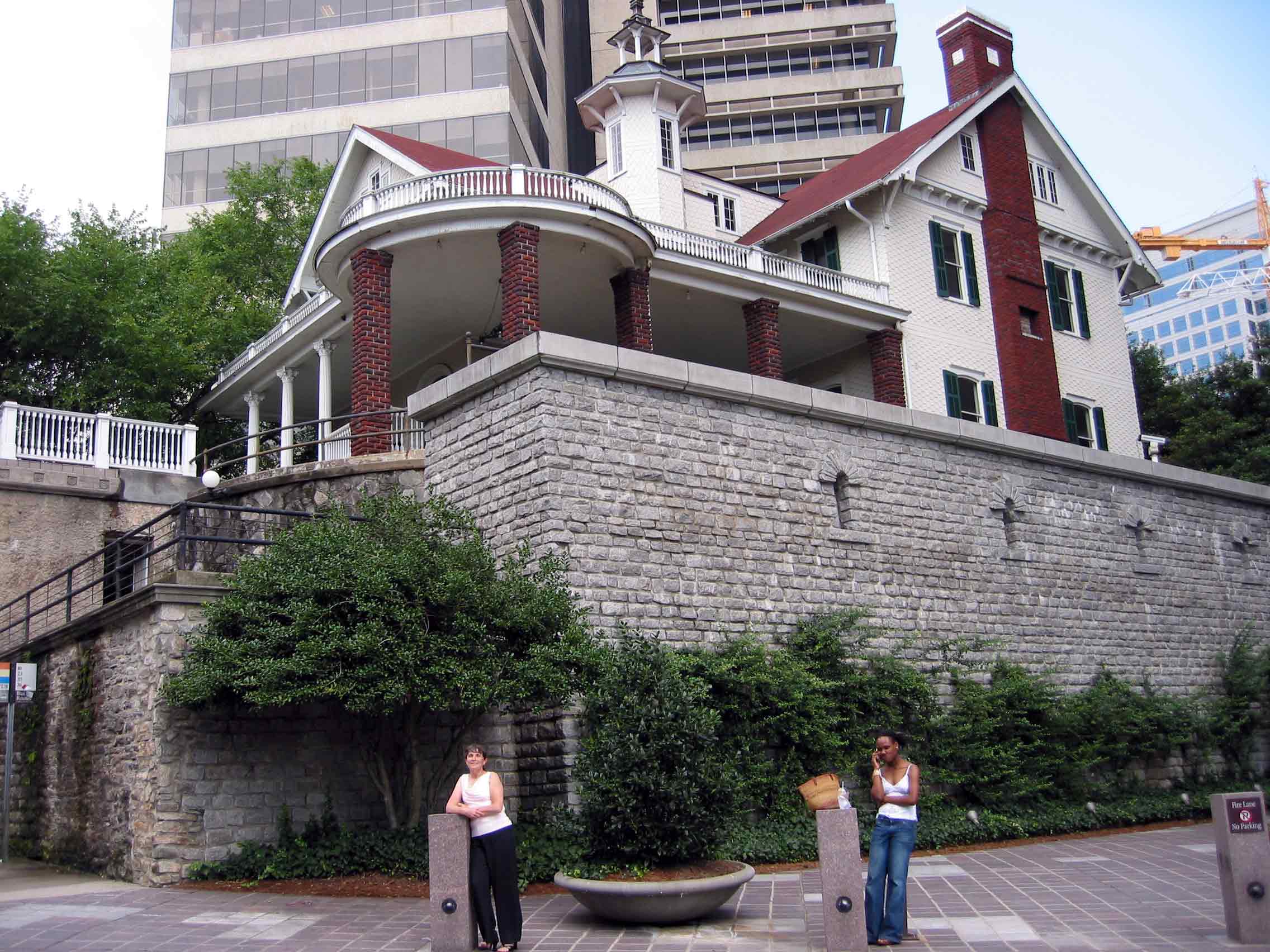 For a year or so (1952-1954) Tedi had been taking the Greyhound bus from Marietta to Atlanta almost five days a week to take classes at the High Museum, and at some point began herself to teach locally out of our house at 405 Lawrence Street in Marietta. She was eventually able to arrange to share a studio space in Hazel Butler Roy's "Castle" at the corner of 15th and Peachtree with two other older women students she had became acquainted with in her classes -- Joel Dinkler (wife of Carling Dinkler, heir to the Dinkler Hotels, who unfortunately ended his life very messily by flinging himself out of one of the plate-glass windows of his downtown hotel) and another well-to-do lady named Alma Hartmann (they both drove big 'ole Cadillac cars!) -- both of whom basically (and fortuitously!) paid the rent on the studio. Tedi's paintings of that period reflected the tastes of her (then) teachers and covered a wide genre of styles (something she herself termed 'trying different things'!). She had a natural eye, however, and was good at picking up different styles and producing quite credible works -- many of which she sold very quickly at local art shows and small galleries (with Jimmy helping out by cutting mats and making frames, and at one busy point she even recruited me to cut mats under Jimmy's guidance -- talk about desperation!). In this way she soon developed a modest, but growing, following among local collectors principally looking for works to decorate their homes. She soon progressed from open-air shows to small galleries, even herself helping to open one or two galleries in conjunction with other artists she had come to know (such as the Browse, Borrow or Buy (BBB) gallery on Peachtree). She was fanatical about separating her "fine-art" career from what she considered her "commercial" career -- only peripherally mentioning her earlier "Hollywood" career in occasional interviews, while keeping the details of her Hollywood background pretty much in the dark, and rarely showing her collection of costume designs to anyone in Georgia, even those inside the family (we knew she had kept a considerable amount of her output from her Edith Head days at Paramount, but it was kept carefully tucked away and we were free to browse through all of it only after she was gone -- see Tedi ). She was dismissive of anything she considered to be 'commercial art' and shunned anything she thought might suggest she was turning out artwork purely to sell!