Post-war Germany was divided in 1945 into four zones administered by the four victorious powers -- the US, Britain, France, and Russia. The Soviets promptly constructed a "fence" along the border between their sector and the so-called Allied sectors, thus dividing Germany in half and effectively creating the "Iron Curtain" between Eastern and Western Europe. The division also created an "island city" out of Berlin, being that it was geograpically located in the middle of the Soviet zone, about 100 miles to the Eastern side of the newly created Iron Curtain. Oddly enough, the city of Berlin (the former capital) had also been divided into four sectors (in 1945), although initially (from 1945 to 1961) there was free movement between all four sectors. This free movement created a window of opportunity for the unregulated movement of both goods and people between the East-West sectors, creating many problems for the Soviets, and on August 17, 1961 the Soviets finally decided to shut it off, thus creating the "Berlin Wall" -- a hastily erected structure of concrete blocks, re-bar, and barbed wire, thrown up almost overnight and effectively dividing the city in half (free movement remained between the three Western sectors of the city, which were virtually indistinguishable, but not to and from the Soviet sector, by then called simply East Berlin).
This was the situation when I arrived in Berlin in April of 1962, i.e., the wall had been up for about 8 months, followed by a continuing series of incidents involving people from the East Zone attempting to escape into the West Zone, occasionally leading to East Zone soldiers firing on unarmed civilians! In a bizarre, warped sort of way it was fascinating, because the incidents that one read about every day in Western newspapers (but never in Soviet-bloc papers!) were being played out constantly all around us. Units of the three Western powers patrolled the city borders constantly in armored vehicles, and linguists such as myself were assigned to monitor Soviet and East-German transmissions (both public and military) to try and keep on top of what the Soviets (and East Germans) were up to! In a sense the duty was blindingly boring, because it was necessary to monitor dozens of communications networks 24 hours a day, most of which involved nothing more than transmissions of the most routine nature -- most frequently "comm checks" in which all the participants in a given "network" would come on the air for perhaps 15 seconds once an hour in order to verify that all the links in the network were present and functioning properly.
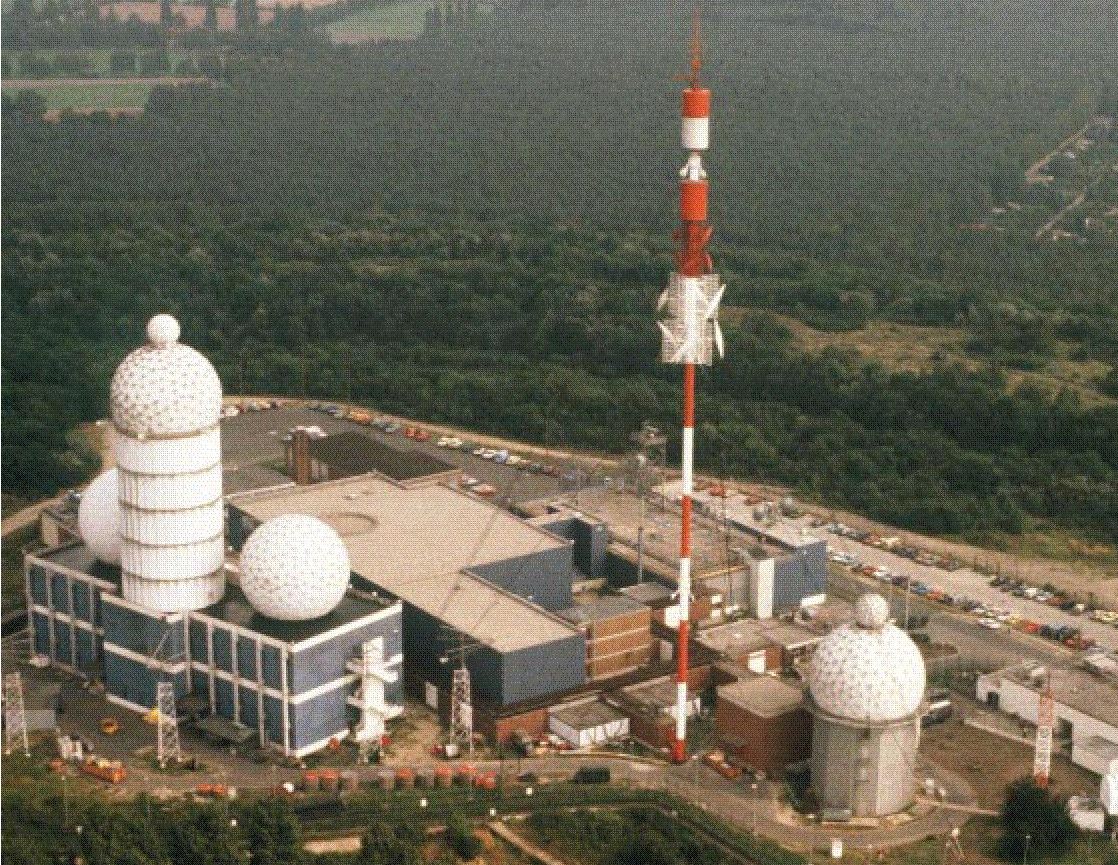
During the first few months after I arrived, our duty station was located at Tempelhof Airport -- the airport of Berlin Airlift fame (when back in 1948-49 the Soviets had suddenly blocked land access between West Germany and Berlin, forcing the Allies to mount an "airlift" to keep the city supplied with essentials -- food, fuel, clothing, etc). Except for some fairly tall buildings, however, Tempelhof Airport is quite low in elevation, and the city of Berlin in general is located in a rather flat river plain with very few prominences suitable for erecting antennas for listening at extended distances. After scratching their heads for a while, US military planners decided to move our listening antennas to a higher point, and after some poking around chose the so-called "Teufelsberg" (Devil's Mountain) a huge hill which had been constructed after WWII somewhat away from the downtown area using rubble from the extensively bombed-out and destroyed city of Berlin. This work had been in progress before I even arrived, and about 6 months after I started duty the whole listening section of which I was a part was moved into a set of vans parked on top of Teufelsberg and surrounded by barbed wire fencing -- mainly to keep out local Germans who had become enthusiastic about using one of the faces of Teufelsberg for a ski jump! In the decades after I left, the vans were replaced with very secure looking concrete bunker-style structures bristling with antennas. However, after the collapse of the Soviet Union circa 1990, the whole facility gradually fell into disrepair as it was apparently used less and less. The last time I visited Berlin circa 2010 the facility had been entirely abandoned and largely painted over with massive graffiti-like, spray-painted "end-of-the-world" messages and looked like something out of a very bad, apocalyptic sci-fi movie!
Andrews Barracks ...
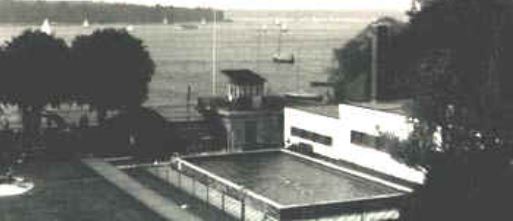
The Kaserne (barracks compound) where I was stationed was quite an elaborate facility on the very upscale street of Finckensteinallee in the toney Lichterfelde district of suburban southern Berlin and was given the post-war American name of Andrews Barracks (after first having removed the Nazi ephemera shown in the photo!). It had had quite a history -- at various times it was the Prussian Cadet Academy, barracks first for Hitler's bodyguard, then the First SS Panzer Division, and also the Waffen SS. For the Olympic Games in 1936 Hitler constructed a 50 meter long by 25 meter wide pool featuring a 10-meter diving platform and a 50-meter track, most of which was still in place when we arrived, and to the best of my knowledge still is (apparently a private members-only facility now!). The neighborhood consisted of beautiful old residential buildings, many of which had survived the Allied bombings (being in a suburban area) and was a wonderful place just to go out and take a walk after duty -- not at all what I had expected when arriving! Not only that, but both a streetcar line and a bus line were located within a block or two of the gate, which provided public transportation all the way downtown (although a bit slow if trying to make it back by midnight curfew, as I discovered at least once!).
The Kaserne was laid out in the German manner with multiple floors, each of the upper floors (living quarters) having a long hallway lined with 8-man rooms. Living space in each room was tight with 4 double-decker bunks, 8 upright clothes closets (4 on each side of the room between the bunks), and 8 foot-lockers stacked on two levels in the center of the room. Bathroom and shower facilities were one large area for each floor, which didn't work too badly since the three working shifts would essentially use it at different times of the day. Each of the 8-man rooms was populated by workers on the same shift, so as to avoid unnecessary sleep conflicts during shift changes.
The first floor of each building was used for a mess hall, storage, and other necessities, while the second floor was devoted to "admin" -- a section which did not fulfill any "mission specific" objectives, but which contained sections for personnel, security, orderly room, mail room, etc. The whole setup was quite German-like in its efficiency and presented an interesting contrast to the typical American barracks-style layout. Since I'm not a devoted students of such things, much of the detail probably escaped my attention ...
Duty at Tempelhof ...
A day or two after arriving and having been assigned "quarters" I climbed on board an Army bus for the half-hour ride to Tempelhof Airport where I settled in to learn various additional intricacies of my trade -- how to tune an R390 HF-band military radio, use a tape recorder, find the john, and (most important of all) how to get to the Air Force mess hall to get a midnight breakfast! (Tempelhof was an Air Force facility, not Army). Two things I learned very quickly about the Air Force in Berlin -- they had an excellent mess, a much friendlier set of cooks than our Army crew, and they did not have a midnight curfew such as we did -- perhaps greatly contributing to their more laid-back attitude (our own Army cooks were a rowdy lot -- one cook who returned drunk from downtown late one night relieved himself absent-mindedly (we assumed!) on a pile of steaks which had just been delivered for dinner the next day, and when the head cook found out about it he ordered that the steaks simply be hosed off and used anyway!). The duty at Tempelhof was a quiet one, punctuated by occasional bursts of activity when the East German army and Soviet army were holding joint exercises. Perhaps the thing that required the greatest adjustment was the "trick-shift" phenomenon, whereby we would work on a day shift for 5 days, take two days of break and rotate to a swing shift for 5 days, take two days of break and rotate to a graveyard shift for 5 days, then repeat the whole thing over and over. The human body does not readily accommodate such continual changes in schedule and tends to rebel, i.e., one continually falls asleep -- something on which the military authorities frown. Of course, the military authorities all worked straight day shifts with five-day weeks and two-day weekends! Oh, well ...
Duty at Teufelsberg ...
After a few months of duty at Tempelhof, we were shifted over to the new facility at Teufelsberg, which involved a much more precarious trip back and forth from Andrews Barracks to the site. Tempelhof was accessible via city streets, and we rode back and forth in a large, rather comfortable bus, which made it easy to doze in both directions. The Teufelsberg site was on the top of a rubble pile where the bombed-out remains of Berlin after the end of WWII had been dumped, and the road up to it was more of a wide trail than an actual road and tended to go through periodic changes in contour as a function of the weather and time of year (Berlin lies at a fairly northerly latitude, and the temperature frequently hovers near zero degree Fahrenheit during the winter!). At this point, someone noticed my deuce-and-a-half credentials, and I was immediately recruited as a shift driver. This involved going over to the motor pool at the start of the shift to pick up a vehicle (thereby missing the mandatory pre-shift inspection -- a real benny!), driving the truck to the site, handing the vehicle and papers over to the driver on the shift being relieved, then at the end of the shift taking the papers and truck from the arriving driver and driving the vehicle back to the motor pool. The only complication was when the weather got nasty, and the truck had trouble staying on the vehicle trail going up or down the hill. One morning, coming down the hill, another driver (one of the site guards, and a bit of a cowboy) had the wheel, and the truck started sliding slowly down the hill sideways. We all saw what was happening and started jumping out of the back of the vehicle while it was still moving slowly enough to do so. The scene rapidly turned chaotic, but eventually the vehicle spun to a slow stop. The driver was relieved (permanently) of his driving duties, but because he was a favorite of the company commander (he was a lineman for the Berliner Bears football team and a real feather in the hat of the commander amongst his peers!) he suffered no long-term consequences ...
The Germans had at one point constructed a small ski jump on the side of Teufelsberg, and on cold winter days (and nights, as it was equipped with a small set of generator-driven lights!) it was a favorite spot for local ski-jumping enthusiasts to try out their skills. It was quite a sight to stand at the top of the run (just outside our little encampment) and watch them disappear at high speed down into the trees. At night there was always a fair share of mulled Glühwein being passed around as well, with the Berliners never failing to offer us a shot (although we were, of course, on duty, sob! ...). The late-1960s photo here shows the ski jump with a plastic matting on it which apparently allowed it to be used well after winter was officially over. The hill was only a few hundred feet high and so presented only modest skiing conditions, but it was the only hill for miles around, with the Harz Mountains all the way to the East/West German border the next closest place for decent skiing ...
My First German Car ...
Berlin is quite a large city, and although it has excellent bus, trolley-car, underground (U-Bahn), and overhead (S-Bahn) train systems readily available, there was for us at that time a catch -- the two high-speed systems (the U-Bahn and S-Bahn systems) were operated by the East Berlin (Communist) authorities, meaning that, as military personnel with security clearances, we were not allowed to use them! This was coupled with the fact that the USAREUR commander at that time (one General Bruce Clark) had decided in his wisdom that US Army enlisted men (not officers, of course!) should be subject to a midnight curfew, i.e., back in the barracks at midnight, which due to the size of Berlin could be very difficult to do using a bus or streetcar (the Air Force was not subject to such a curfew, only the Army -- major bummer!). The best apparent solution -- buy a car, of course!
So, pretty soon I'm standing downtown in front of a used car lot (much like those back in the US, except with oily, fast-talking German salesmen, instead of oily, fast-talking American salesmen!) looking at pretty dishy Mercedes sedans, and at that time (1962) you could pick up a 1955 Mercedes for about $400 -- the four marks to a dollar exchange rate had a lot to do with that. I took a test ride and never looked back! Unfortunately, when I took the car to the the Post motor pool for safety testing, they told me that there was considerable rust on the underside of the chassis, and that it would cost me $100 to have enough welding done to take care of it -- in fact, the soldier at the motor pool even recognized the car as having belonged to another soldier who had had to get rid of it because he couldn't afford to have it welded! I had been suckered in beautifully, but the car was still a very decent Mercedes so I ponied up the money to have the work done and suddenly became mobile. When I left Berlin a little over a year later, I sold the car to another GI in our barracks who also got very good usage out of it, although he got a better deal that I did since he only paid me $300 for it (hey, this was 50 years ago!) ...
The car definitely expanded my range of mobility, and I spent many days just cruising around the city exploring the three Western sectors -- the rather industrial French sector in the Northern part of the city, the British sector which included most of the fashionable downtown area around the "Kudamm" in the Central part of the city, and the more upscale and residential American sector in the Southern part of the city, including the area where we were stationed. Having a car also gave me the flexibility to drive along the long "wall" which the East Germans had built through the middle of the city, separating East and West Berlin -- something which very much reinforced the reality of what Berlin had been subjected to. It also gave me the freedom to explore the Wannsee area -- a lake resort area in the American sector, a portion of which had been converted into an Army recreation area on the grounds of an old mansion with a large beach and boating area, on which I went sailing a number of times with a barracks mate who was quite a good sailor. The area was apparently a former Nazi resort area, as well, where it was rumored numerous bodies had been tossed into the lake at various times! The twentieth century reality of Berlin was a set of contradictions to which there were no real answers ...
Berlin Nightlife ...
Berlin has always been noted for its cosmopolitan scene, but in particular for a mixture of both straight and gay nightlife (think Kurt Weill, Lotte Lehman, Mack the Knife, and the Roaring Twenties). For simple soldiers, however, a more immediate source of entertainment was the GI bar scene in the American sector, which stretched intermittently down Unter den Eichen -- a sometimes swish, sometimes louche street not far from Andrews Barracks. The GI bar scene in the States is a very sordid affair which one avoids at all costs for fear of various "social diseases." I had also completely avoided the GI bar scene in Frankfurt and Baumholder for similar reasons, however one of my new roommates (Charlie H.) in the barracks in Berlin insisted that I join him on a round of his favorite bars. His rationale was that the bar scene in Berlin was quite different from those in other places in that there was a much wider spectrum of young ladies that frequented the bars -- many of them clerks, secretaries, and other working-class girls simply out for an evening of dancing and fun, and not hookers at all! That sounded somewhat optimistic, but at his insistence I joined him on several occasions for a bit of bar-hopping in various venues (the Unter den Eichen scene, bars catering to AF personnel in the Tempelhof area, one or two German bars, and several in parts of town I only vaguely recall). Most of the bars were places where you could buy a watered-down drink and ask any of the ladies in attendance to dance. He was right in that the young ladies seemed quite pleasant and, in fact, surprisingly normal, and it certainly afforded opportunities to polish up one's German-language skills. However, it would also be an exaggeration to say that any of the girls were opera or concert goers or had attended any recent plays at the local theaters -- they were basically working-class girls with an occasional hooker thrown in!
In addition to the GI bar scene, there were a couple of other types of bars I would visit occasionally with one or two other barracks' buddies (Dave S. and Tom F.) -- "German" bars and "International" bars. The German bars were frequented mainly by Germans, with only an occasional curious GI showing up -- the Badewanne (Bathtub) was one such bar, featuring telephones at each table where one could dial any other table in the room and start up a conversation. The "International" style of bar (such as the downtown Eden Club) were somewhat like tourist bars, but contained a distinct "gay" element as well. The Eden Club (there were actually two, both favorites of Tom F.) had a large central area with a bar for drinking and dancing, along with multiple rooms that one could wander in and out of carrying a drink, with each room having a distinctive decor (some would have films playing which projected on large sections of the walls, others would have different kinds of non-dance music playing, all of them had a somewhat smoky, surrealistic air!). Some of the rooms also had very comfortable couches and armchairs for lounging about, but no actual beds! I remember an odd experience one evening while standing at the bar -- Tom F. introduced me to a friend of his who had just wandered in, whom Tom had known from his (unfinished!) college days back in Michigan. This guy claimed that he had made a small fortune starting up laundromats in Germany (unheard of at the time) and bragged that he had slept with several well-known ingenue actresses -- sort of a non-sequitur in a downtown Berlin bar. I stopped visiting the downtown bars after one evening when I had to resort to taking the streetcar back to the barracks after Tom (who had driven) became enamored with one of the bar girls and refused to leave. I arrived about 15 minutes after curfew and slipped in unreported only because a changing of the guard was taking place. I slipped past the gate by telling one guard that another guard who had just lined up for the "changing of the guard" formation had already checked my ID -- a very close call which could have resulted in my being confined to barracks for several weeks, or something even more serious depending on how well I was getting along with the administrative staff sergeants at any given time! My call at leaving without Tom turned out to be a good one though, as he turned his little Austin-Healey Sprite sports car onto its side coming around a sharp curve in a wooded part of the Grünewald on the way back to the barracks. Because of the late hour, he was able to get out, flip the car back on its wheels and continue unobserved. He did, however, end up with 15 days restriction for having returned after curfew, not to mention a rather scratched-up car ...
Viktoria-Studienhaus ...
After quite a few evenings of doing the Berlin bar scene, I had the good luck to get set up on a double date with a young German college student at the downtown Technische Hochschule. The guy who set us up was Andy S. (see below). His date was an architecture student he had met while attending a concert downtown, and he fixed me up with a student named Mette who was studying Advertising (Werbung). We made sure we impressed the young ladies by taking them to a very nice French restaurant called the Pavillon du Lac, which was actually the French Officers Club in the French sector, and to which we had access by virtue of our military IDs (even though we were enlisted, not officers -- the French apparently couldn't distinguish that detail on our IDs). Again, cost was nominal -- less than $10 each for a very nice French dinner with full linen and silver table service, along with champagne!
As a result, over the next year of my service in Berlin, I had access to a very interesting group of young female students in a residence hall right in downtown Berlin called the Viktoria-Studienhaus. One of them (a girl named Jutta) I dated on and off both during my stay in Berlin, as well as afterwards, visiting her both at her home in Duisburg as well as later when I was living in Paris, although at some point we mutually decided it probably wasn't going anywhere (over a period of two years, Jutta underwent the transformation which seems to be very common in German women -- going from a cute young Fraulein to a bourgeois "Hausfrau" -- my bad, probably, for being so shallow, but there is a certain German-ness of mindset involved which demands a conformity to German norms that someone brought up in America like myself simply has trouble wrapping their head around!).
At one point I introduced Tom to one of the girls in the Viktoria-Studienhaus and from then on until my departure Tom and I spent all of our free time visiting and dating the girls there. It was a huge cut above the bar scene -- I remember one evening when two of the girls who were studying singing (Gesang) put on an impromptu performance for us in one of the practice rooms at Viktoria-Studienhaus -- one of them (an English student named Chris) even singing the fiendishly difficult "Queen of the Night" aria from Mozart's opera "The Magic Flute" while accompanying herself at the piano -- a bravura performance! The other, a young Scottish lass, was dating a male singer who was a roommate of James King, one of the leading baritones of the West Berlin opera scene of the 1960s (East Berlin and West Berlin had separate opera houses -- quite an expense!). The whole scene was a long way from Charlie H.'s evening bar-hopping activities -- at one point Charlie tried to get me to fix him up with one of the German coeds, but I had to gently tell him I didn't think his somewhat ham-handed GI-bar approach to things would be much appreciated. We didn't communicate much after that, which was awkward because we bunked in the same room!
Musical Life in Berlin ...
One of the advantages of being in Berlin, as opposed to the small border villages to which many of the Monterey grads were sent, was the musical life. The West German government was temporarily headquartered in Bonn, Germany until, as the Germans never ceased to hope, the country would be reunited (not until 1990, a long way off in the early 1960s!). But West German politicians looked at Berlin both as their future capital, as well as a propaganda object for the East Germans to envy, since it sat almost 100 miles behind the border, smack in the middle of East Germany. As a result they pumped large amounts of money into rebuilding the city into a model of how Capitalism was superior to Communism. This included generous support for the arts -- music, theater, museums, public spaces, etc. West Berlin had its own first-rate opera house (Deutsche Oper), a well-funded music school with concert hall (Hochschule für Musik), many restored churches with excellent organs and acoustics, and while I was there they built a new modern concert hall for the Berlin Philharmonic right next to the border (a modern, rather odd-looking building plopped right on the border where the East Germans couldn't fail to see it!), although I left before it was completed and so have never actually attended a concert there! I did get a chance to attend many operas, however, as the tickets were subsidized by the West German government (10 marks for an excellent balcony seat at a time when there were 4 marks to a dollar!). Concerts at the Hochschule für Musik were typically 2-4 marks, and the continual round of church concerts (in particular organ concerts and the Bach passions) were free! The spring before I left was marked by a round of four major requiems in four different churches -- Verdi, Berlioz, Brahms, and Mozart -- again with excellent gallery seats for free!
Barracks Folk...
Sigma and E. B. -- There was an expression back in our day, "You have to have enough tread to go the twenty ..." which meant that the twenty years of active military service that were required to retire at full pay amounted to plucking an 18-year-old fresh out of high school and turning him into a grizzled 38-year-old sergeant with a full military pension, i.e., 100% of base pay for the rest of your life after retirement -- a real "benny" (code for "benefit"). From this came the colorful expression "tread" to refer to grizzled old sergeants, of which we had our share, in particular Sigma W. and E. B. A. Both of these gentlemen came equipped with rather fully rounded stomachs, balding heads, substantial double chins, and an uncertain background in language skills (Sigma had actually completed a 37-week course in Polish at Monterey, but had limited skills in even recognizing when a tank operator on the radio was speaking Polish rather than, say, Russian, when they came on the air during military exercises!). Both considered themselves to be quite competent bridge players and showed up at the base Service Club every week to play, as well as to compete for the Monthly Masterpoint. Most other evenings were simply spent in the NCO Club drinking beer and hanging out with other aging sergeants. They rarely left the Kaserne and might just as easily have been serving at Fort Benning in Georgia or Fort Hood in Texas. They suffered greatly during the annual drive to score high on the Europe-wide Army Physical Fitness tests, which were a sort of competition between the various units in any given specialty (Intelligence versus Infantry, for instance -- an interesting, if not terribly competitive, matchup!). E.B. almost threw his arm out in the "grenade throw" part of the competition, and both struggled mightily to keep up (much less lead) the daily runs to "get the troops into shape" -- an unlikely status for an Intelligence unit!
Tom S. -- A very interesting linguist on our shift was Tom S. -- an artist who was taking advantage of his time in Berlin to study pottery-making with a skilled local German sculptor/teacher who taught at the hobby shop in the basement of the Service Club once a week. Tom eventually developed into a highly skilled worker in clay and, after leaving the service and returning to his native state of Ohio, became a locally well-known artist.
Tom was also an enthusiastic cyclist, and it was he who introduced me to Erich Polauke, a local mechanic in downtown Berlin who specialized in making racing-class bike frames and assembling bicycles around them for local enthusiasts -- the mention of a "Polauke Fahrrad" (bicycle) was enough to bring knowledgeable folk out of the woodwork to take a look (although his fame, admittedly, was somewhat local!). Tom took a European discharge about 3 months before I did and spent that time cycling around parts of southern Europe, principally Italy and Spain. As we were returning to the Kaserne on the duty bus one afternoon, someone looked out the window and said, "Ugh, look at that grubby hippie guy out there on a bicycle!" and "Waddayaknow!" it turned out to be Tom, who had come back to Berlin for a last visit to his instructor in the hobby shop before heading back to Ohio! By that time I was one of the few left who knew Tom, so I got off the bus, vouched for Tom so he could get in to visit his German friend, and spent about a week hanging out with him and meeting Erich Polauke of “Polrad” racing bicycle fame, from whom I ended up buying a very expensive ($150!) 10-speed bicycle which I would use as my chief mode of transportation (that and my thumb stuck out while standing on the side of the road!) for the next couple of years after I took a European discharge. I never saw Tom again after that, but would occasionally read about his pottery output in various clay pottery publications. Herr Polauke, the bicycle maker, was also a fascinating guy -- a Pole who had fled westwards as the Soviets were advancing through Poland at the end of the war and who, somehow or other, had lost the lower half of one of his arms -- a terrible loss for a mechanic. He had somehow made it to Berlin, where he settled in, married a local Fraulein, and started up his little bicycle-frame-making shop in Berlin Charlottenburg (downtown Berlin). It must have been terribly difficult getting established during his first years, but eventually he made quite a success out of it. The last time I was in there, however, I noticed that he had included a small counter of candies he sold to the local children, perhaps a modest supplement to the somewhat seasonal nature of his bicycle-making income ...
Andy S. -- Andy showed up on our working shift one evening and, his being of a friendly nature, we got to know each other quite well. He had taken a 37-week course at Monterey in (I believe) Russian and worked as an operator on our shift for the rest of the time I was in Berlin. He had played hockey casually in grade school and high school, and we would frequently go over to a local park with a frozen pond where he would show me how to push a hockey puck around the ice! It was a great way to spend the cold winter days, and we would even occasionally participate in pickup hockey games with various German teen-agers who would also show up at the pond with hockey sticks. It was he who introduced me to the girls at Viktoria-Studienhaus, for which I was greatly indebted. Many years later (about 50 actually), I dropped a note to Andy to see what he was up to and received a rather cryptic note from his adult son, referring me to a newspaper article. Like many of the linguists who were college dropouts, Andy had gone back and finished college after his military service was over, then parlayed his language skills into a career in the CIA. He had traveled all over the world without incident in the course of his career (including apparently Vietnam in the late 60s), and one afternoon dropped by a favorite burger hangout of his in Tysons Corner, Virginia (the DC suburb where CIA is located). As he was entering the restaurant, a cook who had just been laid off from the restaurant drove his car at high speed into the large plate-glass window in the front of the restaurant, completely wiping out Andy in the process. CIA? Assassination attempt? Probably not, just a disgruntled cook! Oh, dear ...
Biella -- After I had been in Berlin for several months, the next class in line to graduate from ALS in Monterey showed up, of whom two members ended up working in our unit as transcribers, first at Tempelhof then later at Teufelsberg -- Dennis K. and Stu S. I mention them because I remained in contact with both of them for many years afterwards. A third member of their class, a guy named Biella, was a very skilled pop piano player who spent evenings performing at a piano bar on the pier in Monterey (probably to the detriment of his Russian studies and to the despair of his teachers!). Biella spent quite a bit of time at various Berlin bars (more often drinking than playing) and was frequently two sheets to the wind when he showed up for duty (never a certainty). He eventually also took a European discharge. I heard later from Stu that Biella had been hitchhiking in Southern France and had been picked up by a driver in one of the very lightweight Citroens called a 2CV ('deux chevaux' referring perhaps to their engines, fabled to be only two horsepower!), which subsequently collided head-on with another much larger car, with all the occupants of the 2CV being killed instantly -- a great shock to all of us who knew Biella (and undoubtedly a considerable loss to the bar-piano-playing population of Southern France!).
Stu S. -- I maintained intermittent contact with Stu S., and after he also obtained a European discharge he found a room in Paris and spent part of the spring and summer of 1964 there while studying French and preparing himself to go back to school. I hitchhiked through there at one point and stopped to visit him, tossing my sleeping bag on the floor of the little room he was renting over on the Boulevard Raspail in the Latin Quarter (15th Arrondissement). The visit was of great significance to me because when I returned to Paris later in the fall of that same year I found it almost impossible to find a room to rent. He had told me about a place called L'Association France États-Unis, which was a French-US friendship organization that had good tips to give to American students about places to rent (and which I later made good use of!). Stu eventually went back to graduate school and ended up in the banking business where he did quite well, ending up with residences in both DC and Philadelphia and a good-sized sailboat he kept in a slip right on Chesapeake Bay. Stu was one of only a few people I knew from that time who managed to wholly escape the Russian language scene as far as his eventual career went!
Dennis K. -- Another friend from my Berlin days that I stayed in contact with for many years was Dennis K. His story is of interest because it is typical of the careers that many of the Monterey Russian-linguist crowd pursued after the end of their service days. Dennis arrived in Berlin equipped with a wife, which conveniently enabled him to avoid the hassles of the army barracks' scene entirely. They rented a small apartment within walking distance of Andrews Barracks, and during the year that followed Dennis was able to largely extract himself from the daily hassles of military life. After finishing his service, he went back to school to get his degree in American History at U Mass, while at the same time he and his wife, Kay (a charming lady), produced 3 children! After he graduated, he found it difficult to support his family on his salary from a high-school teaching job, so he signed up with NSA -- presumably as a Russian linguist, although possibly teaching American history to dependent children, something that was off limits for discussion since my own clearance had lapsed some 10 or 15 years earlier when I left Berlin! He was eventually sent to a site called Menwith Hill near Harrogate in central England where he spent 7 years doing whatever folks do at such places. (While working at SRI I was once sent to Harrogate to repair an antenna controller "somewhere in Central England" and unexpectedly found myself at Menwith Hill, for which I had no clearance and had to be escorted everywhere, including the john! The entrance to the site had an unexpected encampment with lots of anti-American signs saying things like "NSA Get Out" which made for a certain amount of excitement just getting in and out of the place!). Dennis had developed a bit of the "tread" mentality and enjoyed the life there, but Kay apparently tired of it and wanted to return to the States, which they did, although sadly it eventually led to the breakup of their marriage! I relate all of this because one day a few years later and to our great surprise Dennis showed up on the doorstep of our little house in the Skylonda area of Woodside, CA. He was interviewing for a marketing job with a firm that supplied electronics for systems such as those at Menwith Hill, and stayed with us for several days -- his stay being marked by the falling of a neighbor's tree directly on the top of our house on February 28th, 1983 during an exceptionally strong El Nino storm out of the southwest (an unusual direction for heavy winds). Not to be deterred, Dennis moved into a local hotel while we dealt with the fallout from the tree (which destroyed a good bit of our house). Dennis got the spot he was interviewing for, eventually moved into the next-door house we bought as a result of the tree disaster, and remained there for several months. Being an enterprising type, he struck up a friendship with a young English divorcee on the other side of us and moved in with her for about 5 years! They eventually went their separate ways, with Dennis then taking a job with Sun Microsystems, marketing their computer systems to customers in the Arab world and operating out of a swish bachelor pad in Dubai! At some point, Sun went under, and Dennis dropped off our radar. Dennis had gone through several ups and downs in his career, at one point working as a taxi driver in San Diego, so we fully expected him to rise from the ashes again, but so far it hasn't happened ... Our inquiries among other friends from those long ago days lead only to a shrug of the shoulders -- not a good sign, but one must never give up hope! (One former friend who was unexpectedly indifferent to our inquiries is the English divorcee from next door, who told us that the next time we see him we should tell him to get stuffed!)
From One to Three Cars (Dave S.) ...
Of the many and varied folks I met in the service, and particularly in Berlin, Dave was probably he most colorful. He was a liberal-arts major from somewhere in Kansas who had arrived in Berlin several months before I did, promptly acquired a VW bug and a German girl-friend named Dagmar, and spent most of his time on the road between the barracks and the Wedding quarter of Northern Berlin -- a working-class area in the French sector where his girl-friend lived. I ran into him when I first started working on the same shift -- he asked where I had gone to school and I gave him my standard cover answer of "Boston Tech" (actually MIT's original name before it relocated from downtown Boston to the other side of the Charles River in Cambridge). After he found out what Boston Tech really was, he thought that to have been a very clever answer and a good way of avoiding unwelcome attention, and from that we gradually became good friends. We would spend long evenings at the Wannsee EM club which had a very elegant dining room overlooking the lake and which served excellent steaks (the Germans ate mostly pork, and beef was at a premium in Berlin, probably because of difficulties in transporting it from West Germany through the Soviet zone). He was a great lover of German white wines -- in particular two varieties called Zeller Schwarze Katz (a Mosel wine) and Kröver Nacktarsch (a Riesling) -- actually not terribly expensive wines, but very tasty German semi-sweet varieties. In addition, Dave loved smoking great black cigars with a glass of brandy after dinner and gradually seduced me into joining him now and again -- terrible habits that one picks up in one's youth! We would occasionally move these proceedings from the American Wannsee EM Club setting to the French Tegelsee Officers' Club setting where the excellent Pavillon du Lac restaurant with its white linen tablecloths and napkins was located (again, for some reason we were allowed to dine at the officers' club, even though we were enlisted men, not officers!).
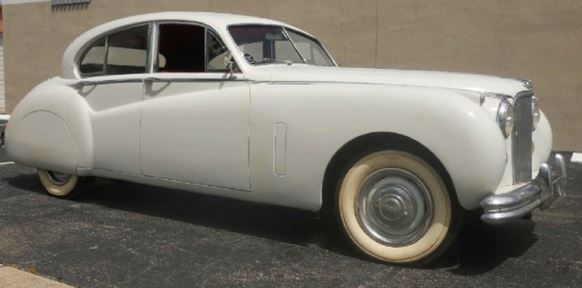
At some point, Dave felt that he wanted to upgrade his image a bit (don't we all at one time or another!), and he began looking around for a somewhat more "up-market" vehicle than his little Beetle. He soon found what he was looking for on the NAAFI bulletin board. The Brits, of course, had their own sector complete with market and store, just like our Commissary and PX, and the complex which housed all of this was called NAAFI (Navy, Army, Air Force Institute!). Listed on the bulletin board was an ad for a 1952 Jaguar Mark VII 'Saloon' replete with leather upholstery, teak dashboard, removable 'spats' on the rear wheels, and all the bells and whistles which whisper seductively into the ear of a young American GI with a roll of bucks burning a hole in his 'trousers'! Dave absolutely had to see this car and drove out to the British barracks to take a look. It was love at first site! The car was in cherry condition and maintained by a guy named 'Staff Stott' who was a sergeant in the 'Army of the Rhine' motorpool. And he only wanted $400 for it! End of story -- Dave bought the car on the spot ...
Well, not quite the end of the story -- more like the beginning of another story! 'Staff Stott' was the name of a British Staff Sergeant named Bob Stott, who along with his wife Jean became very good friends of ours. They had a nice apartment in the British housing area and liked to entertain, and Bob also liked to keep a weather eye out on how his Jaguar, which he had restored with loving care, was doing! After all, he'd sold it to a 'bloody Yank' and who could know what was going to happen to it? We hung out with them quite a bit and learned to appreciate the British take on 'the good life' which involved a lot of standing around beat-up old upright pianos drinking ale and singing corny Brits' drinking songs, and also inexplicably included drinking something called a 'grasshopper' -- equal parts of Crème De Cacao, Crème de Menthe, and just cream -- a truly ghastly drink which British women seem to love (apparently turning them into roaring tigers according to British men -- at least those in the Royal Motor Pool of the Army of the Rhine)! Another of our cellmates back at the barracks, one Peter (? -- name long ago forgotten) had grown up in the midwest, joined the service after high school, and after going through various Army training courses ended up in Berlin as an "analyst" -- someone who took the transcripts we provided and tried to fold them into a larger scenario, eventually to be used by civilian analysts ("the real analysts") back at Fort Meade, Maryland (NSA HQ!) as part of a "larger" picture, something we never saw! Peter was one of our buds back at the Kaserne and soon joined us in our rounds with Staff Stott and fellows. As part of Peter's initiation into our select group, Jean Stott introduced him to her hairdresser -- a rather statuesque German blond who sported one of those trendy hairdos of the early sixties known as a 'beeshive' -- hair rolled up into a tall bouffant, almost tower-like, structure and adorned with various glistening bits of tinsel-like objects -- quite a sight for a simple hick from the midwestern cornfields! Despite his stern upbringings, Peter folded like a tent at the sight of this unexpected level of big-city glamour and sophistication. However, a few months later as he prepared to return to the States at the end of his tour, he realized the effect such a sight would have on the simpler folks from his midwestern hometown and sorrowfully opted to leave his newfound German treasure back in Berlin -- probably a very wise decision! The girl herself was quite saddened by this unexpected turn of events, but probably realized the buried wisdom behind his decision.
At some point I inadvertently spilled the beans to Dave about my plans to get a European discharge and spend a couple of years cycling around Europe during the summers and holing up in places like Vienna and Paris during the winters. He immediately grabbed onto this plan and said we'd have to do it together and form a sort of intellectual collective, perhaps even with our mutual friend Tom S., the potter -- Dave would be the literary muse, I would represent the musical side of things(!), and Tom would handle the plastic arts! This was all fueled, of course, by copious quantities of large dark cigars and brandy, but even at that sounded quite far-fetched. With lots of free time on our hands, however, it didn't hurt to fantasize a bit, so soon Dave was trying to figure out what sort of transportation would be suitable and I found myself in new car salons on the Kurfurstendamm checking out everything from a Citroen 2CV ($800) to a Renault convertible ($3000)! Dave discovered that Bob Stott had an Opel mini-station-wagon in his possession that we could buy for around $300, and that became his next acquisition target, buying it almost immediately to bring his stable up to three cars!
Things were really starting to get serious! About this time Dave began to worry about the financial viability of his proposed "grand plan" and over dinner one night suggested the bizarre scheme of raising a pile of cash by "running guns from Germany to Turkey." Dave had always been something of a gun freak, but this was a side of him I had never seen before. I suddenly had the feeling that what up until then had been sort of a lark to fantasize about during dinner at the Wannsee pavillion had suddenly turned into something way out on the far side. I had never taken the whole thing very seriously before, but now I began to really worry about how to bail out gracefully.
Suddenly Dave came up with another another outlandish plan, namely to "screw the treads" as he put it and make them think he was going re-enlist to become an Sergeant E6 (not just a Specialist E6!), while he was actually going to take a stateside leave to visit his "dying father" and get a hardship discharge while in the States. Afterwards he would return to join us in Europe (my discharge was scheduled to occur a couple of months later than his). He actually carried out the plan to the extent that he obtained a stateside leave to visit his father (who was in fact very elderly, but not actually dying!). As a part of this transaction, I suddenly found myself the keeper of three cars -- my Mercedes, Dave's Jaguar (signed legally over to me), and the Opel station wagon (already partly mine, and now totally!). However, when Dave went to the local Army recruitment office in his hometown back in Kansas to see about arranging for the stateside discharge, they told him that because of his Top-Secret security clearance it simply wouldn't be possible and that it would have to take place in Berlin where he held the clearance! I was very surprised to see him show up back in the mess hall one morning after I had finished working the midnight shift, and I immediately asked him how in the world he had gotten back. He said it was very simple -- he took a cab from his home to the airport, plunked down $300 for a one-way flight to Berlin, and a few hours later he landed at Tempelhof! Our local administration was none the wiser, and he applied for a hardship discharge to take care of his ailing father, which he obtained. We quietly sold the cars (there was always an active trading scheme of cars among the very transient GI population), and a week or two later he got on a flight back to the States. We corresponded briefly, but he soon moved on to some other (probably equally outlandish) scheme or phase of his life, and I never saw or heard from him again -- to my considerable relief I must admit!
A Visit from the States ...
At the same time that all of the above melodrama was playing out, another scenario was developing in the background! Tedi had always wanted to travel to Europe to get ideas for her art, and my impending European discharge seemed to present a good opportunity to make a visit! She put together a scheme by which Jimmy would take a month off from work (difficult for him to do because of his busy schedule and his desire not to get out of the flow of a job which he had deservedly acquired, but without the appropriate education). The general idea was that I would hang on to the little Opel station wagon Dave and I had acquired, and we would use that as transportation for the trip (Dave was by then long gone!). Planning was moving ahead swimmingly, but then one night (actually early one morning about 2 am) while cycling across downtown Berlin on my newly acquired "Polrad" the front tire of the bike slipped into a streetcar track while I was going full speed and flipped me over the handle bars as it came to a dead stop! I tried to get up, but realized I had broken something, which turned out to be my left collarbone! I was in a bit of a fix because I was out after curfew -- I had taken a 3-day pass, but the pass didn't begin until 6 am the next morning and I had gotten a head start on things by leaving the barracks early and was now out after midnight! After gathering my wits, I picked myself and my bicycle up and began walking very slowly (and painfully) towards the military hospital not far from Andrews Barracks. I ended up sitting in a tram stop and dozing fitfully for several hours until 6 am arrived, then limped into the hospital (probably not one of the more glorious days of my life!). Treatment for a broken collarbone involves what's called a figure-eight sling in which both arms are held 24 hours a day for several weeks in order to immobilize the broken bone. It's one of those things that is very painful, but eventually heals itself. The really terrible part about it was that I was forced to cancel Tedi and Jimmy's trip -- something which I have always deeply regretted because Jimmy was never able to re-schedule it and consequently never made to Europe (he had a decent knowledge of both German and French from his Rheinland-Hessian father's family and his Alsatian mother's family and would have very much liked to visit the places they came from!). Tedi did make the trip a few weeks later and was apparently able to parley a good bit of it into use in her subsequent paintings!
From Three Cars to One Bicycle ...
Another bit of fallout from my accident had to do with the fact that the melodrama with Dave S. had arrived at a sort of end-game state at that point. Not knowing at that point that Dave was actually coming back to Berlin, I was trying to get the various cars ready to sell, when I discovered that the Jaguar refused to start. The Stotts were back in England on leave, so I had to try and figure things out by myself (it wasn't really even my car!). I can still remember the pain of trying to work on that Jaguar while recovering from a broken clavicle (sort of a one-armed act!), but I was eventually able to get the starter motor out, replace the brushes (not easy to find in Berlin), then stick the thing back in the car, after which time the beast blessedly agreed to start up -- Hallelujah! A series of rapid-fire vehicle transfers took place over a period of two or three weeks, and my wonderful 15-month stay in Berlin slogged to an unexpectedly melodramatic end -- I put myself and my bike on the duty train and headed for West Germany and Frankfurt, which was to be my informal headquarters for the next two-plus years (it would be several years before I owned a car again, and until that time I was happy to go with my 'Polrad' ...)

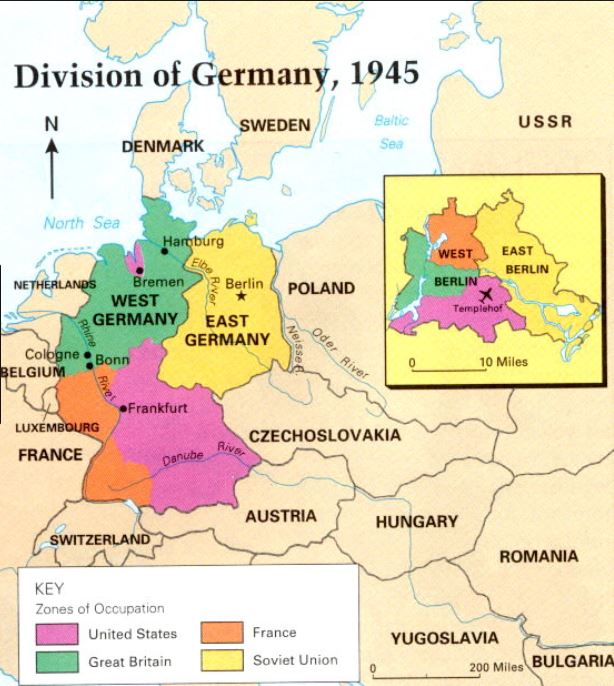 The division also created an "island city" out of Berlin, being that it was geograpically located in the middle of the Soviet zone, about 100 miles to the Eastern side of the newly created Iron Curtain. Oddly enough, the city of Berlin (the former capital) had also been divided into four sectors (in 1945), although initially (from 1945 to 1961) there was free movement between all four sectors. This free movement created a window of opportunity for the unregulated movement of both goods and people between the East-West sectors, creating many problems for the Soviets, and on August 17, 1961 the Soviets finally decided to shut it off, thus creating the "Berlin Wall" -- a hastily erected structure of concrete blocks, re-bar, and barbed wire, thrown up almost overnight and effectively dividing the city in half (free movement remained between the three Western sectors of the city, which were virtually indistinguishable, but not to and from the Soviet sector, by then called simply East Berlin).
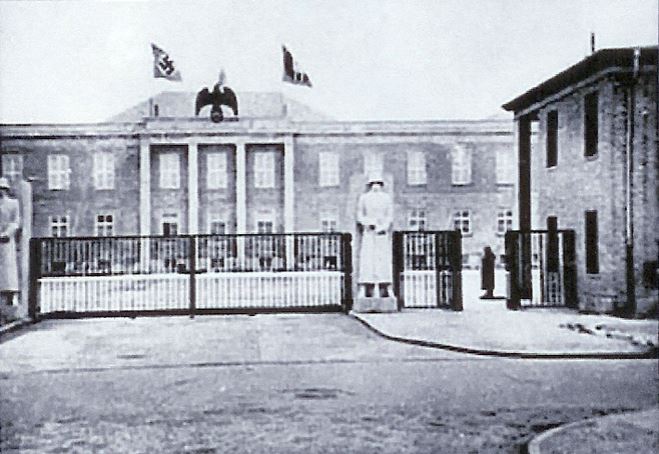 It had had quite a history -- at various times it was the Prussian Cadet Academy, barracks first for Hitler's bodyguard, then the First SS Panzer Division, and also the Waffen SS. For the Olympic Games in 1936 Hitler constructed a 50 meter long by 25 meter wide pool featuring a 10-meter diving platform and a 50-meter track, most of which was still in place when we arrived, and to the best of my knowledge still is (apparently a private members-only facility now!). The neighborhood consisted of beautiful old residential buildings, many of which had survived the Allied bombings (being in a suburban area) and was a wonderful place just to go out and take a walk after duty -- not at all what I had expected when arriving! Not only that, but both a streetcar line and a bus line were located within a block or two of the gate, which provided public transportation all the way downtown (although a bit slow if trying to make it back by midnight curfew, as I discovered at least once!).
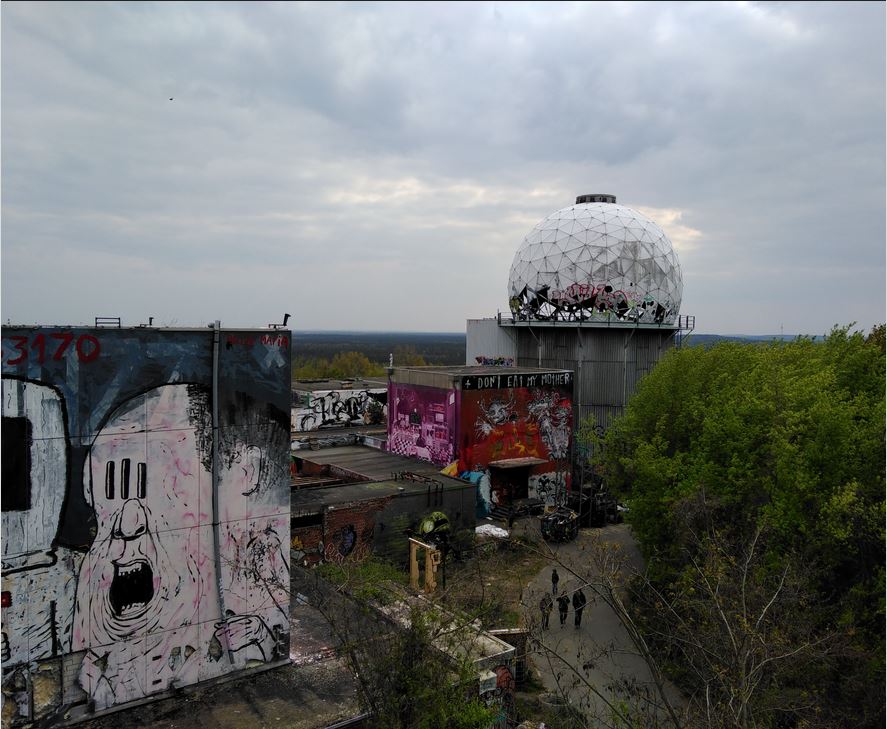 Tempelhof was accessible via city streets, and we rode back and forth in a large, rather comfortable bus, which made it easy to doze in both directions. The Teufelsberg site was on the top of a rubble pile where the bombed-out remains of Berlin after the end of WWII had been dumped, and the road up to it was more of a wide trail than an actual road and tended to go through periodic changes in contour as a function of the weather and time of year (Berlin lies at a fairly northerly latitude, and the temperature frequently hovers near zero degree Fahrenheit during the winter!). At this point, someone noticed my deuce-and-a-half credentials, and I was immediately recruited as a shift driver. This involved going over to the motor pool at the start of the shift to pick up a vehicle (thereby missing the mandatory pre-shift inspection -- a real benny!), driving the truck to the site, handing the vehicle and papers over to the driver on the shift being relieved, then at the end of the shift taking the papers and truck from the arriving driver and driving the vehicle back to the motor pool. The only complication was when the weather got nasty, and the truck had trouble staying on the vehicle trail going up or down the hill. One morning, coming down the hill, another driver (one of the site guards, and a bit of a cowboy) had the wheel, and the truck started sliding slowly down the hill sideways. We all saw what was happening and started jumping out of the back of the vehicle while it was still moving slowly enough to do so. The scene rapidly turned chaotic, but eventually the vehicle spun to a slow stop. The driver was relieved (permanently) of his driving duties, but because he was a favorite of the company commander (he was a lineman for the Berliner Bears football team and a real feather in the hat of the commander amongst his peers!) he suffered no long-term consequences ...
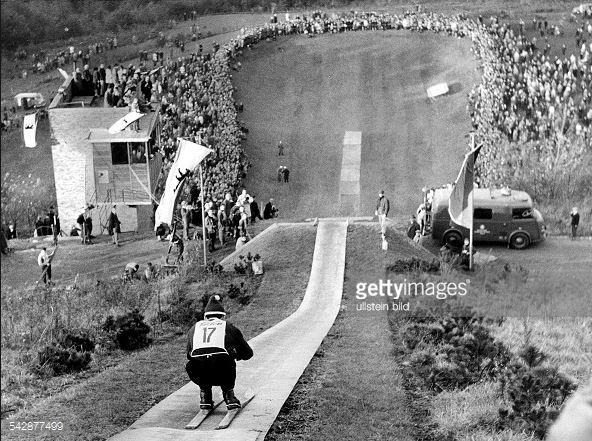 It was quite a sight to stand at the top of the run (just outside our little encampment) and watch them disappear at high speed down into the trees. At night there was always a fair share of mulled Glühwein being passed around as well, with the Berliners never failing to offer us a shot (although we were, of course, on duty, sob! ...). The late-1960s photo here shows the ski jump with a plastic matting on it which apparently allowed it to be used well after winter was officially over. The hill was only a few hundred feet high and so presented only modest skiing conditions, but it was the only hill for miles around, with the Harz Mountains all the way to the East/West German border the next closest place for decent skiing ...
 in the American sector, a portion of which had been converted into an Army recreation area on the grounds of an old mansion with a large beach and boating area, on which I went sailing a number of times with a barracks mate who was quite a good sailor. The area was apparently a former Nazi resort area, as well, where it was rumored numerous bodies had been tossed into the lake at various times! The twentieth century reality of Berlin was a set of contradictions to which there were no real answers ...
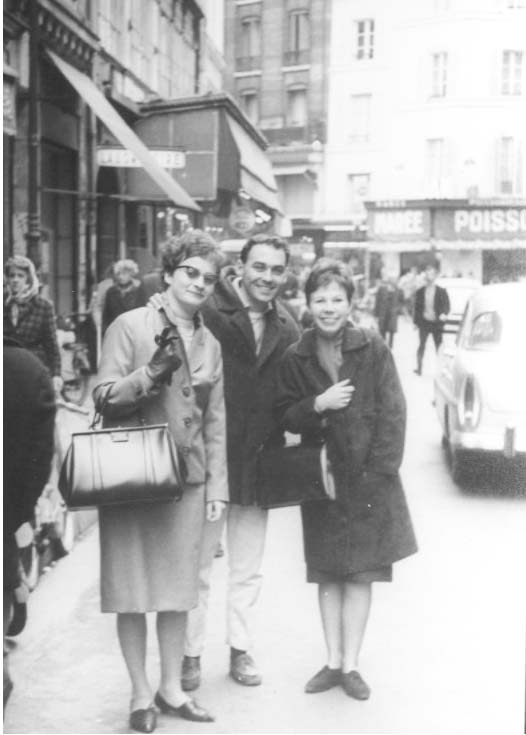 As a result, over the next year of my service in Berlin, I had access to a very interesting group of young female students in a residence hall right in downtown Berlin called the Viktoria-Studienhaus. One of them (a girl named Jutta) I dated on and off both during my stay in Berlin, as well as afterwards, visiting her both at her home in Duisburg as well as later when I was living in Paris, although at some point we mutually decided it probably wasn't going anywhere (over a period of two years, Jutta underwent the transformation which seems to be very common in German women -- going from a cute young Fraulein to a bourgeois "Hausfrau" -- my bad, probably, for being so shallow, but there is a certain German-ness of mindset involved which demands a conformity to German norms that someone brought up in America like myself simply has trouble wrapping their head around!).
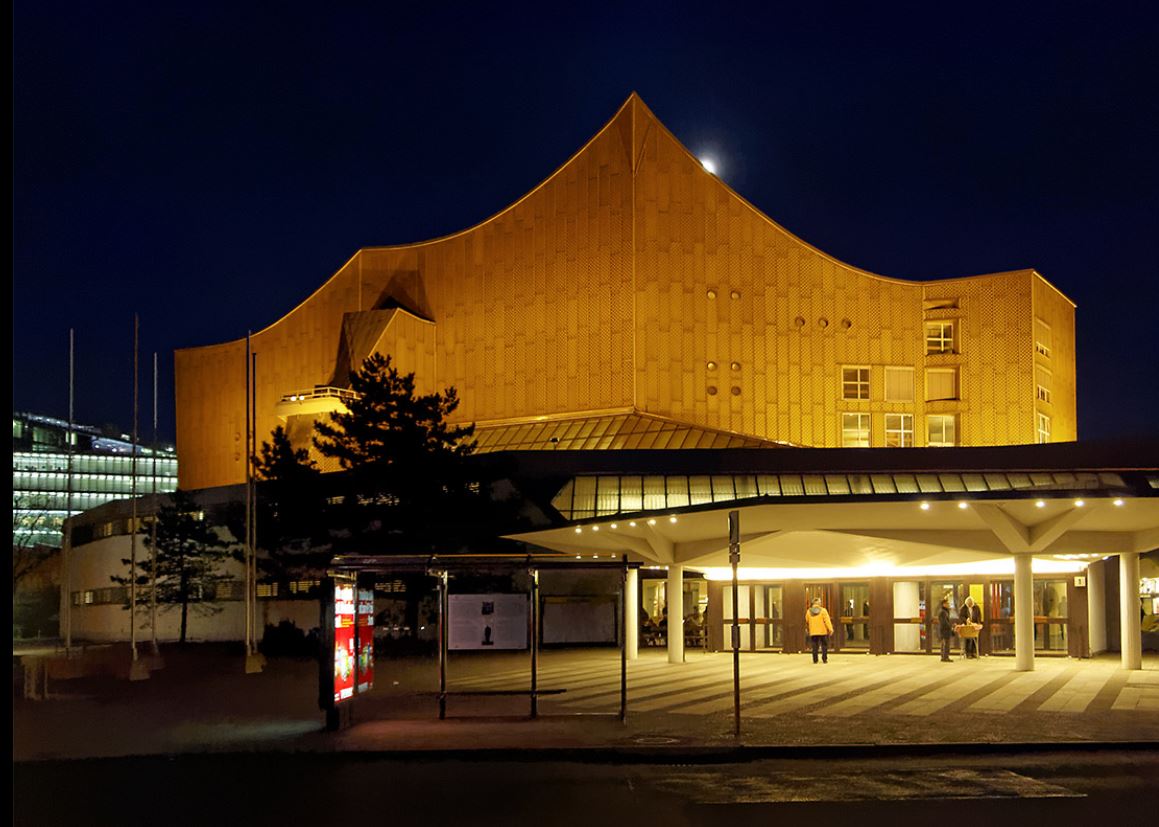 The West German government was temporarily headquartered in Bonn, Germany until, as the Germans never ceased to hope, the country would be reunited (not until 1990, a long way off in the early 1960s!). But West German politicians looked at Berlin both as their future capital, as well as a propaganda object for the East Germans to envy, since it sat almost 100 miles behind the border, smack in the middle of East Germany. As a result they pumped large amounts of money into rebuilding the city into a model of how Capitalism was superior to Communism. This included generous support for the arts -- music, theater, museums, public spaces, etc. West Berlin had its own first-rate opera house (Deutsche Oper), a well-funded music school with concert hall (Hochschule für Musik), many restored churches with excellent organs and acoustics, and while I was there they built a new modern concert hall for the Berlin Philharmonic right next to the border (a modern, rather odd-looking building plopped right on the border where the East Germans couldn't fail to see it!), although I left before it was completed and so have never actually attended a concert there! I did get a chance to attend many operas, however, as the tickets were subsidized by the West German government (10 marks for an excellent balcony seat at a time when there were 4 marks to a dollar!). Concerts at the Hochschule für Musik were typically 2-4 marks, and the continual round of church concerts (in particular organ concerts and the Bach passions) were free! The spring before I left was marked by a round of four major requiems in four different churches -- Verdi, Berlioz, Brahms, and Mozart -- again with excellent gallery seats for free!
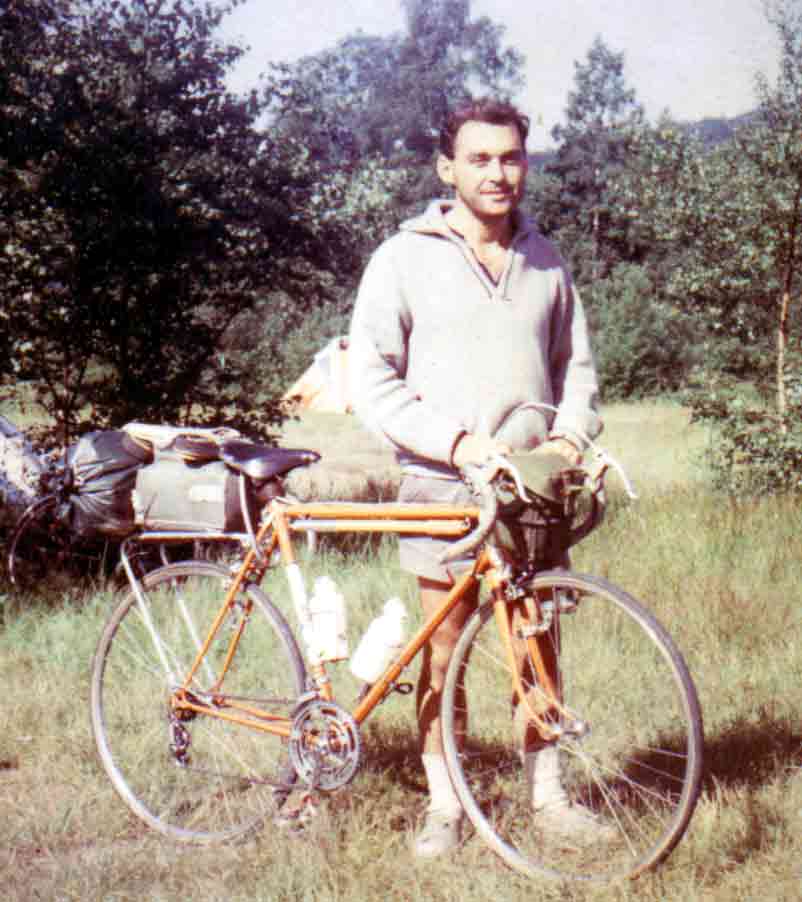 Tom was also an enthusiastic cyclist, and it was he who introduced me to Erich Polauke, a local mechanic in downtown Berlin who specialized in making racing-class bike frames and assembling bicycles around them for local enthusiasts -- the mention of a "Polauke Fahrrad" (bicycle) was enough to bring knowledgeable folk out of the woodwork to take a look (although his fame, admittedly, was somewhat local!). Tom took a European discharge about 3 months before I did and spent that time cycling around parts of southern Europe, principally Italy and Spain. As we were returning to the Kaserne on the duty bus one afternoon, someone looked out the window and said, "Ugh, look at that grubby hippie guy out there on a bicycle!" and "Waddayaknow!" it turned out to be Tom, who had come back to Berlin for a last visit to his instructor in the hobby shop before heading back to Ohio! By that time I was one of the few left who knew Tom, so I got off the bus, vouched for Tom so he could get in to visit his German friend, and spent about a week hanging out with him and meeting Erich Polauke of “Polrad” racing bicycle fame, from whom I ended up buying a very expensive ($150!) 10-speed bicycle which I would use as my chief mode of transportation (that and my thumb stuck out while standing on the side of the road!) for the next couple of years after I took a European discharge. I never saw Tom again after that, but would occasionally read about his pottery output in various clay pottery publications. Herr Polauke, the bicycle maker, was also a fascinating guy -- a Pole who had fled westwards as the Soviets were advancing through Poland at the end of the war and who, somehow or other, had lost the lower half of one of his arms -- a terrible loss for a mechanic. He had somehow made it to Berlin, where he settled in, married a local Fraulein, and started up his little bicycle-frame-making shop in Berlin Charlottenburg (downtown Berlin). It must have been terribly difficult getting established during his first years, but eventually he made quite a success out of it. The last time I was in there, however, I noticed that he had included a small counter of candies he sold to the local children, perhaps a modest supplement to the somewhat seasonal nature of his bicycle-making income ...